 The strongest, smartest open source multi-stage model fine tune for consumer hardware ever and BUILT on consumer hardware via Unsloth.
The first model of this size/type to breach "700" ARC-C in both 8 bit and 4 bit; hench the "711" in the name.
This model (both 4 bit and 8 bit) exceeds the base Qwen 3.6 27B in 6 out of 7 benchmarks, and matches it on the 7th AND exceeds all 7 benchmarks for Qwen3.6-35B-A3B.
The 700 "intelligence club" is reserved for OpenAI, Claude and Gemini closed source models.
This is the one they fear.
This is a multi-stage fine tune, multi-fine tune, and multi-stage merge.
A Colab between myself (multiple fine tunes, including multi-stage), Nightmedia (merge/benching), TeichAI (Polaris Dataset), armand0e (Light fable 5 traces) and trohrbaugh (heretic'ing the model).
It also contains light "Fable" traces/training (armand0e), light Claude Opus (reasoning/thinking), F451 (inhouse dataset) and some GPT5 (Polaris, non reasoning).
The strict goals of this model creation were:
- Increase the general model intelligence and problem solving abilities.
- DO NOT modify/damage or change the core model outside this goal.
- ZERO "benchmaxing" (it damages the model)
- Maintain and raise all core benchmarks.
CORE MISSION::
Improve instruction following and problem solving. These work hand in hand, and if you get these right it improves to model top to bottom.
It took a lot of tests on Qwen 3.5 9Bs to get the methods right.
And it worked and can be used on other models too.
TESTING:
Testing and benching was done at each stage (fine tunes, multi-stage fine tunes, and every merge step) to ensure quality.
Final testing was HUMAN testing. (you can also see benchmarks below too)
Human testing means side by side testing of the base/org model and new model.
Features:
- Improved instruction following.
- Overall increase in general intelligence and problem solving.
- Better thinking/reasoning.
- Even lower/lowest quants are exceptional.
- Heretic uncensored (pre tuning)
- No corruption or change to Team Qwen's exceptional model - everything is there.
- Vision
Regular and MTP GGUFS:
All quants (regular and MTP) are NEO IMATRIX, which improve accuracy of the quants by an additional 2-4% over normal GGUFs as well as long context performance.
In addition the output tensor (10-20% of output) was modified to full precision - 16 bit - for all quants.
"MTP" GGUFS (multi-token prediction):
- "MTP" GGUFS will have "MTP" in the name as a suffix.
- I have also set the MTP tensors to Q8_0 precision for all quants.
- To get better performance keep temp 1 or less (higher temps degrade MTP performance).
- Likewise with rep pen ; keep at 1 (off). If you raise it performance will suffer.
- If you see "token acceptance" rates BELOW 50% (predict 2 tokens) switch to normal quants.
SPEED:
- On Q4_K_S (4bit) quant, regular GGUFs are about 75 t/s, whereas MTP GGUFs (acceptance at 60%, 2 tokens) can exceed 90 T/S. (5090, Windows 11, testing in LMStudio)
- Speeds will vary depending on GPU(s), AI app, O/S (Linux/Mac will generally be faster) and hardware.
- "MTP" quants speeds will vary ; for creative/complex and/or temps over 1 use regular GGUFs for better performance.
I suggest you download at least one of each - regular and MTP gguf(s) - and test them for your use case(s).
If you get "token acceptance" (predict 2 tokens) with MTP quant(s) BELOW 50% (this means regular quants will run faster), then regular GGUF(s) will actually perform better - ie faster.
MTP quant(s) can in some cases run faster as the token window fills up and/or in multi turn chats.
Note there is NO other diffence between the quants type besides speed: both will do the same job.
Model:
- 256k context
- Gguf quants run in all standard AI apps.
- Vision is activated, but you need to download separate "mmproj" file (ONE) to use it.
VISION:
- Vision (images) tested.
- You need an "mmproj" (just one) of these downloaded too, and placed in the same folder as the GGUF for images.
Qwen Model Settings (suggested):
- Thinking mode for general tasks: temperature=1.0, top_p=0.95, top_k=20, min_p=0.0, presence_penalty=0.0, repetition_penalty=1.0
- Thinking mode for precise coding tasks (e.g. WebDev): temperature=0.6, top_p=0.95, top_k=20, min_p=0.0, presence_penalty=0.0, repetition_penalty=1.0
- Instruct (or non-thinking) mode: temperature=0.7, top_p=0.80, top_k=20, min_p=0.0, presence_penalty=1.5, repetition_penalty=1.0
- Context window min from 8k to 16k.
DE-CENSORING STATS
Special thanks to: "trohrbaugh" for Heretic'ing the model.
# This is a decensored version of [Qwen/Qwen3.6-27B](https://huggingface.co/Qwen/Qwen3.6-27B), made using [Heretic](https://github.com/p-e-w/heretic) v1.2.0+custom with the [Arbitrary-Rank Ablation (ARA)](https://github.com/p-e-w/heretic/pull/211) method
## Performance
| Metric | This model | Original model ([Qwen/Qwen3.6-27B](https://huggingface.co/Qwen/Qwen3.6-27B)) |
| :----- | :--------: | :---------------------------: |
| **KL divergence** | 0.0469 | 0 *(by definition)* |
| **Refusals** | 4/100 | 99/100 |
---
The strongest, smartest open source multi-stage model fine tune for consumer hardware ever and BUILT on consumer hardware via Unsloth.
The first model of this size/type to breach "700" ARC-C in both 8 bit and 4 bit; hench the "711" in the name.
This model (both 4 bit and 8 bit) exceeds the base Qwen 3.6 27B in 6 out of 7 benchmarks, and matches it on the 7th AND exceeds all 7 benchmarks for Qwen3.6-35B-A3B.
The 700 "intelligence club" is reserved for OpenAI, Claude and Gemini closed source models.
This is the one they fear.
This is a multi-stage fine tune, multi-fine tune, and multi-stage merge.
A Colab between myself (multiple fine tunes, including multi-stage), Nightmedia (merge/benching), TeichAI (Polaris Dataset), armand0e (Light fable 5 traces) and trohrbaugh (heretic'ing the model).
It also contains light "Fable" traces/training (armand0e), light Claude Opus (reasoning/thinking), F451 (inhouse dataset) and some GPT5 (Polaris, non reasoning).
The strict goals of this model creation were:
- Increase the general model intelligence and problem solving abilities.
- DO NOT modify/damage or change the core model outside this goal.
- ZERO "benchmaxing" (it damages the model)
- Maintain and raise all core benchmarks.
CORE MISSION::
Improve instruction following and problem solving. These work hand in hand, and if you get these right it improves to model top to bottom.
It took a lot of tests on Qwen 3.5 9Bs to get the methods right.
And it worked and can be used on other models too.
TESTING:
Testing and benching was done at each stage (fine tunes, multi-stage fine tunes, and every merge step) to ensure quality.
Final testing was HUMAN testing. (you can also see benchmarks below too)
Human testing means side by side testing of the base/org model and new model.
Features:
- Improved instruction following.
- Overall increase in general intelligence and problem solving.
- Better thinking/reasoning.
- Even lower/lowest quants are exceptional.
- Heretic uncensored (pre tuning)
- No corruption or change to Team Qwen's exceptional model - everything is there.
- Vision
Regular and MTP GGUFS:
All quants (regular and MTP) are NEO IMATRIX, which improve accuracy of the quants by an additional 2-4% over normal GGUFs as well as long context performance.
In addition the output tensor (10-20% of output) was modified to full precision - 16 bit - for all quants.
"MTP" GGUFS (multi-token prediction):
- "MTP" GGUFS will have "MTP" in the name as a suffix.
- I have also set the MTP tensors to Q8_0 precision for all quants.
- To get better performance keep temp 1 or less (higher temps degrade MTP performance).
- Likewise with rep pen ; keep at 1 (off). If you raise it performance will suffer.
- If you see "token acceptance" rates BELOW 50% (predict 2 tokens) switch to normal quants.
SPEED:
- On Q4_K_S (4bit) quant, regular GGUFs are about 75 t/s, whereas MTP GGUFs (acceptance at 60%, 2 tokens) can exceed 90 T/S. (5090, Windows 11, testing in LMStudio)
- Speeds will vary depending on GPU(s), AI app, O/S (Linux/Mac will generally be faster) and hardware.
- "MTP" quants speeds will vary ; for creative/complex and/or temps over 1 use regular GGUFs for better performance.
I suggest you download at least one of each - regular and MTP gguf(s) - and test them for your use case(s).
If you get "token acceptance" (predict 2 tokens) with MTP quant(s) BELOW 50% (this means regular quants will run faster), then regular GGUF(s) will actually perform better - ie faster.
MTP quant(s) can in some cases run faster as the token window fills up and/or in multi turn chats.
Note there is NO other diffence between the quants type besides speed: both will do the same job.
Model:
- 256k context
- Gguf quants run in all standard AI apps.
- Vision is activated, but you need to download separate "mmproj" file (ONE) to use it.
VISION:
- Vision (images) tested.
- You need an "mmproj" (just one) of these downloaded too, and placed in the same folder as the GGUF for images.
Qwen Model Settings (suggested):
- Thinking mode for general tasks: temperature=1.0, top_p=0.95, top_k=20, min_p=0.0, presence_penalty=0.0, repetition_penalty=1.0
- Thinking mode for precise coding tasks (e.g. WebDev): temperature=0.6, top_p=0.95, top_k=20, min_p=0.0, presence_penalty=0.0, repetition_penalty=1.0
- Instruct (or non-thinking) mode: temperature=0.7, top_p=0.80, top_k=20, min_p=0.0, presence_penalty=1.5, repetition_penalty=1.0
- Context window min from 8k to 16k.
DE-CENSORING STATS
Special thanks to: "trohrbaugh" for Heretic'ing the model.
# This is a decensored version of [Qwen/Qwen3.6-27B](https://huggingface.co/Qwen/Qwen3.6-27B), made using [Heretic](https://github.com/p-e-w/heretic) v1.2.0+custom with the [Arbitrary-Rank Ablation (ARA)](https://github.com/p-e-w/heretic/pull/211) method
## Performance
| Metric | This model | Original model ([Qwen/Qwen3.6-27B](https://huggingface.co/Qwen/Qwen3.6-27B)) |
| :----- | :--------: | :---------------------------: |
| **KL divergence** | 0.0469 | 0 *(by definition)* |
| **Refusals** | 4/100 | 99/100 |
---
 [](https://chat.qwen.ai)
> [!Note]
> This repository contains model weights and configuration files for the post-trained model in the Hugging Face Transformers format.
>
> These artifacts are compatible with Hugging Face Transformers, vLLM, SGLang, KTransformers, etc.
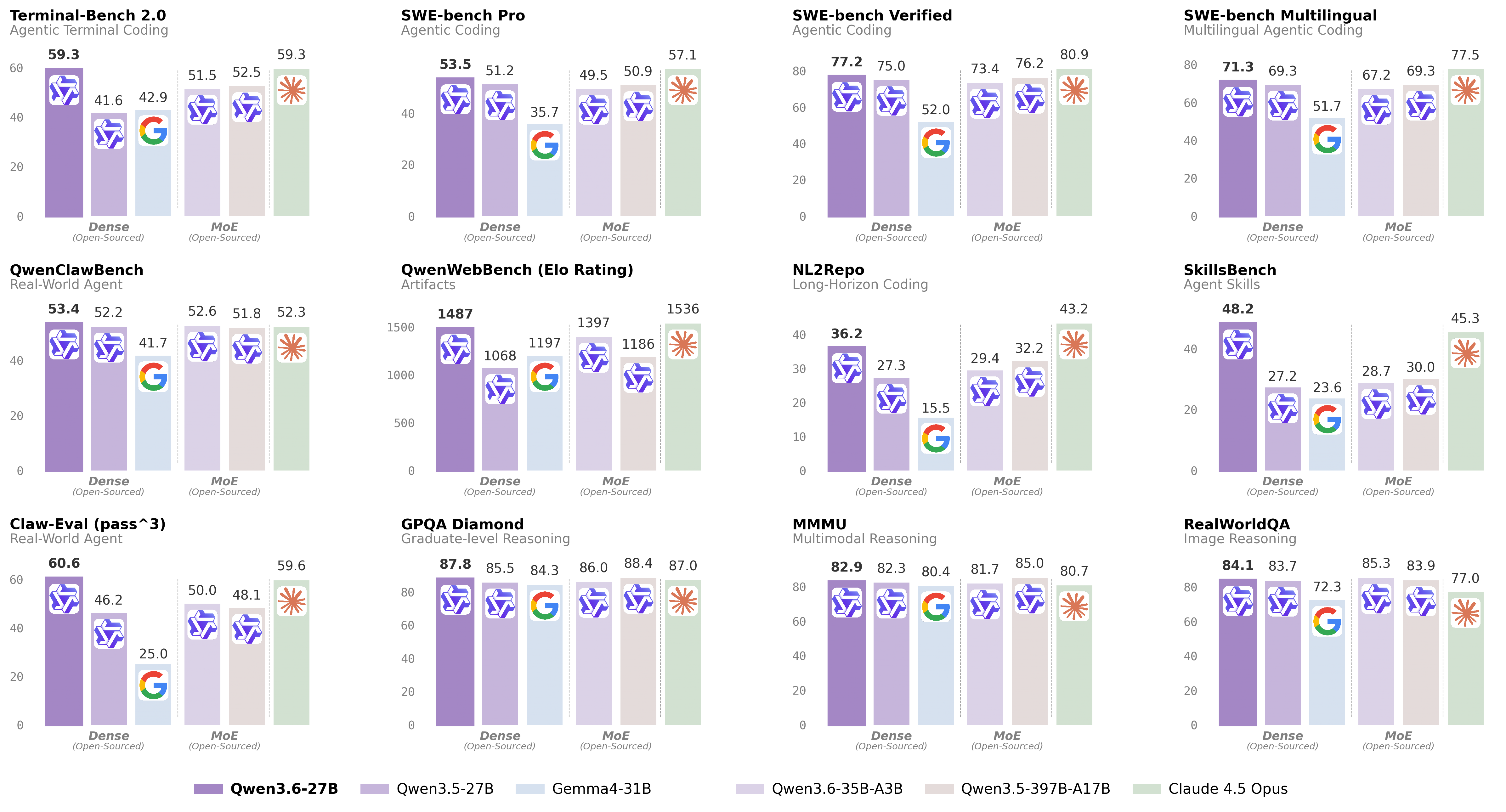
Following the February release of the Qwen3.5 series, we're pleased to share the first open-weight variant of Qwen3.6. Built on direct feedback from the community, Qwen3.6 prioritizes stability and real-world utility, offering developers a more intuitive, responsive, and genuinely productive coding experience.
## Qwen3.6 Highlights
This release delivers substantial upgrades, particularly in
- **Agentic Coding:** the model now handles frontend workflows and repository-level reasoning with greater fluency and precision.
- **Thinking Preservation:** we've introduced a new option to retain reasoning context from historical messages, streamlining iterative development and reducing overhead.
For more details, please refer to our blog post [Qwen3.6-27B](https://qwen.ai/blog?id=qwen3.6-27b).
## Model Overview
- Type: Causal Language Model with Vision Encoder
- Training Stage: Pre-training & Post-training
- Language Model
- Number of Parameters: 27B
- Hidden Dimension: 5120
- Token Embedding: 248320 (Padded)
- Number of Layers: 64
- Hidden Layout: 16 × (3 × (Gated DeltaNet → FFN) → 1 × (Gated Attention → FFN))
- Gated DeltaNet:
- Number of Linear Attention Heads: 48 for V and 16 for QK
- Head Dimension: 128
- Gated Attention:
- Number of Attention Heads: 24 for Q and 4 for KV
- Head Dimension: 256
- Rotary Position Embedding Dimension: 64
- Feed Forward Network:
- Intermediate Dimension: 17408
- LM Output: 248320 (Padded)
- MTP: trained with multi-steps
- Context Length: 262,144 natively and extensible up to 1,010,000 tokens.
## Benchmark Results
### Language
[](https://chat.qwen.ai)
> [!Note]
> This repository contains model weights and configuration files for the post-trained model in the Hugging Face Transformers format.
>
> These artifacts are compatible with Hugging Face Transformers, vLLM, SGLang, KTransformers, etc.
Following the February release of the Qwen3.5 series, we're pleased to share the first open-weight variant of Qwen3.6. Built on direct feedback from the community, Qwen3.6 prioritizes stability and real-world utility, offering developers a more intuitive, responsive, and genuinely productive coding experience.
## Qwen3.6 Highlights
This release delivers substantial upgrades, particularly in
- **Agentic Coding:** the model now handles frontend workflows and repository-level reasoning with greater fluency and precision.
- **Thinking Preservation:** we've introduced a new option to retain reasoning context from historical messages, streamlining iterative development and reducing overhead.

For more details, please refer to our blog post [Qwen3.6-27B](https://qwen.ai/blog?id=qwen3.6-27b).
## Model Overview
- Type: Causal Language Model with Vision Encoder
- Training Stage: Pre-training & Post-training
- Language Model
- Number of Parameters: 27B
- Hidden Dimension: 5120
- Token Embedding: 248320 (Padded)
- Number of Layers: 64
- Hidden Layout: 16 × (3 × (Gated DeltaNet → FFN) → 1 × (Gated Attention → FFN))
- Gated DeltaNet:
- Number of Linear Attention Heads: 48 for V and 16 for QK
- Head Dimension: 128
- Gated Attention:
- Number of Attention Heads: 24 for Q and 4 for KV
- Head Dimension: 256
- Rotary Position Embedding Dimension: 64
- Feed Forward Network:
- Intermediate Dimension: 17408
- LM Output: 248320 (Padded)
- MTP: trained with multi-steps
- Context Length: 262,144 natively and extensible up to 1,010,000 tokens.
## Benchmark Results
### Language
| Qwen3.5-27B | Qwen3.5-397B-A17B | Gemma4-31B | Claude 4.5 Opus | Qwen3.6-35B-A3B | Qwen3.6-27B | |
|---|---|---|---|---|---|---|
| Coding Agent | ||||||
| SWE-bench Verified | 75.0 | 76.2 | 52.0 | 80.9 | 73.4 | 77.2 |
| SWE-bench Pro | 51.2 | 50.9 | 35.7 | 57.1 | 49.5 | 53.5 |
| SWE-bench Multilingual | 69.3 | 69.3 | 51.7 | 77.5 | 67.2 | 71.3 |
| Terminal-Bench 2.0 | 41.6 | 52.5 | 42.9 | 59.3 | 51.5 | 59.3 |
| SkillsBench Avg5 | 27.2 | 30.0 | 23.6 | 45.3 | 28.7 | 48.2 |
| QwenWebBench | 1068 | 1186 | 1197 | 1536 | 1397 | 1487 |
| NL2Repo | 27.3 | 32.2 | 15.5 | 43.2 | 29.4 | 36.2 |
| Claw-Eval Avg | 64.3 | 70.7 | 48.5 | 76.6 | 68.7 | 72.4 |
| Claw-Eval Pass^3 | 46.2 | 48.1 | 25.0 | 59.6 | 50.0 | 60.6 |
| QwenClawBench | 52.2 | 51.8 | 41.7 | 52.3 | 52.6 | 53.4 |
| Knowledge | ||||||
| MMLU-Pro | 86.1 | 87.8 | 85.2 | 89.5 | 85.2 | 86.2 |
| MMLU-Redux | 93.2 | 94.9 | 93.7 | 95.6 | 93.3 | 93.5 |
| SuperGPQA | 65.6 | 70.4 | 65.7 | 70.6 | 64.7 | 66.0 |
| C-Eval | 90.5 | 93.0 | 82.6 | 92.2 | 90.0 | 91.4 |
| STEM & Reasoning | ||||||
| GPQA Diamond | 85.5 | 88.4 | 84.3 | 87.0 | 86.0 | 87.8 |
| HLE | 24.3 | 28.7 | 19.5 | 30.8 | 21.4 | 24.0 |
| LiveCodeBench v6 | 80.7 | 83.6 | 80.0 | 84.8 | 80.4 | 83.9 |
| HMMT Feb 25 | 92.0 | 94.8 | 88.7 | 92.9 | 90.7 | 93.8 |
| HMMT Nov 25 | 89.8 | 92.7 | 87.5 | 93.3 | 89.1 | 90.7 |
| HMMT Feb 26 | 84.3 | 87.9 | 77.2 | 85.3 | 83.6 | 84.3 |
| IMOAnswerBench | 79.9 | 80.9 | 74.5 | 84.0 | 78.9 | 80.8 |
| AIME26 | 92.6 | 93.3 | 89.2 | 95.1 | 92.7 | 94.1 |
* SWE-Bench Series: Internal agent scaffold (bash + file-edit tools); temp=1.0, top_p=0.95, 200K context window. We correct some problematic tasks in the public set of SWE-bench Pro and evaluate all baselines on the refined benchmark.
* Terminal-Bench 2.0: Harbor/Terminus-2 harness; 3h timeout, 32 CPU/48 GB RAM; temp=1.0, top_p=0.95, top_k=20, max_tokens=80K, 256K ctx; avg of 5 runs.
* SkillsBench: Evaluated via OpenCode on 78 tasks (self-contained subset, excluding API-dependent tasks); avg of 5 runs.
* NL2Repo: Others are evaluated via Claude Code (temp=1.0, top_p=0.95, max_turns=900).
* QwenClawBench: A real-user-distribution Claw agent benchmark; temp=0.6, 256K ctx.
* QwenWebBench: An internal front-end code generation benchmark; bilingual (EN/CN), 7 categories (Web Design, Web Apps, Games, SVG, Data Visualization, Animation, and 3D); auto-render + multimodal judge (code/visual correctness); BT/Elo rating system.
* AIME 26: We use the full AIME 2026 (I & II), where the scores may differ from Qwen 3.5 notes.
| Qwen3.5-27B | Qwen3.5-397B-A17B | Gemma4-31B | Claude 4.5 Opus | Qwen3.6-35B-A3B | Qwen3.6-27B | |
|---|---|---|---|---|---|---|
| STEM & Puzzle | ||||||
| MMMU | 82.3 | 85.0 | 80.4 | 80.7 | 81.7 | 82.9 |
| MMMU-Pro | 75.0 | 79.0 | 76.9 | 70.6 | 75.3 | 75.8 |
| MathVista mini | 87.8 | -- | 79.3 | -- | 86.4 | 87.4 |
| DynaMath | 87.7 | 86.3 | 79.5 | 79.7 | 82.8 | 85.6 |
| VlmsAreBlind | 96.9 | -- | 87.2 | -- | 96.6 | 97.0 |
| General VQA | ||||||
| RealWorldQA | 83.7 | 83.9 | 72.3 | 77.0 | 85.3 | 84.1 |
| MMStar | 81.0 | 83.8 | 77.3 | 73.2 | 80.7 | 81.4 |
| MMBenchEN-DEV-v1.1 | 92.6 | -- | 90.9 | -- | 92.8 | 92.3 |
| SimpleVQA | 56.0 | 67.1 | 52.9 | 65.7 | 58.9 | 56.1 |
| Document Understanding | ||||||
| CharXiv RQ | 79.5 | 80.8 | 67.9 | 68.5 | 78.0 | 78.4 |
| CC-OCR | 81.0 | 82.0 | 75.7 | 76.9 | 81.9 | 81.2 |
| OCRBench | 89.4 | -- | 86.1 | -- | 90.0 | 89.4 |
| Spatial Intelligence | ||||||
| ERQA | 60.5 | 67.5 | 57.5 | 46.8 | 61.8 | 62.5 |
| CountBench | 97.8 | 97.2 | 96.1 | 90.6 | 96.1 | 97.8 |
| RefCOCO avg | 90.9 | 92.3 | -- | -- | 92.0 | 92.5 |
| EmbSpatialBench | 84.5 | -- | -- | -- | 84.3 | 84.6 |
| RefSpatialBench | 67.7 | -- | 4.7 | -- | 64.3 | 70.0 |
| Video Understanding | ||||||
| VideoMME(w sub.) | 87.0 | 87.5 | -- | 77.7 | 86.6 | 87.7 |
| VideoMMMU | 82.3 | 84.7 | 81.6 | 84.4 | 83.7 | 84.4 |
| MLVU | 85.9 | 86.7 | -- | 81.7 | 86.2 | 86.6 |
| MVBench | 74.6 | 77.6 | -- | 67.2 | 74.6 | 75.5 |
| Visual Agent | ||||||
| V* | 93.7 | 95.8 | -- | 67.0 | 90.1 | 94.7 |
| AndroidWorld | 64.2 | -- | -- | -- | -- | 70.3 |
* Empty cells (--) indicate scores not yet available or not applicable.